About the Program
M.Pharm in Pharmaceutical Chemistry
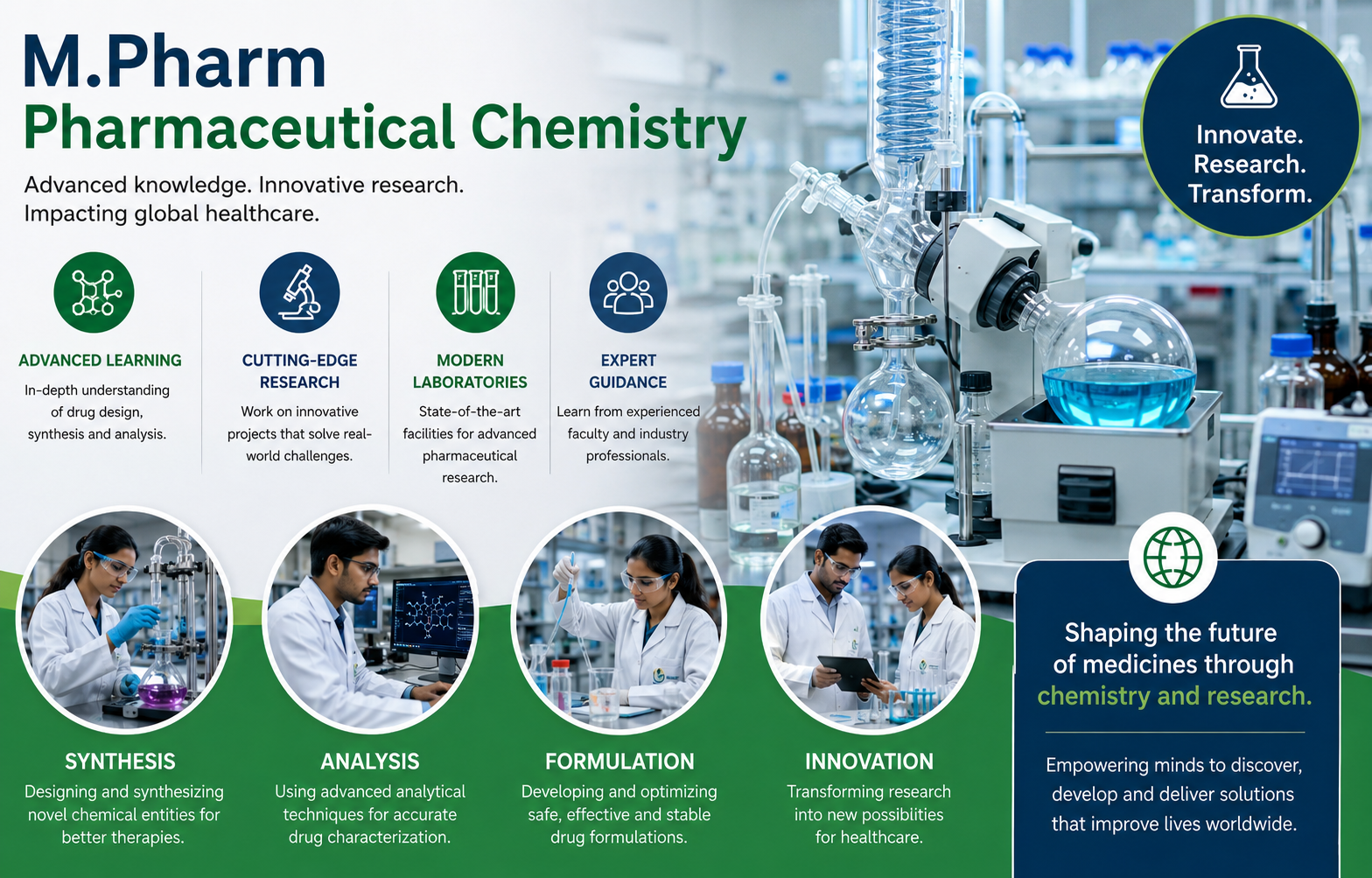
Advance your expertise in the science of medicines with the M.Pharm in Pharmaceutical Chemistry program at Asha Pharmacy College. This postgraduate program is designed for pharmacy graduates who aspire to build careers in drug discovery, medicinal chemistry, pharmaceutical analysis, quality research, and the pharmaceutical industry.
The curriculum combines advanced theoretical knowledge with intensive laboratory training, enabling students to understand the design, synthesis, characterization, and evaluation of pharmaceutical compounds. Students gain hands-on experience with modern analytical instruments and research methodologies while working under the guidance of experienced faculty.
The program also emphasizes innovation, scientific research, regulatory compliance, and industry-oriented learning, preparing graduates for opportunities in pharmaceutical manufacturing, research organizations, clinical laboratories, quality assurance, academia, and higher research.
Eligibility
Admission to the M.Pharm – Pharmaceutical Chemistry program at Asha Pharmacy College is open to candidates who meet the following requirements:
Minimum Qualification
- Bachelor’s degree (B.Pharm) from a recognized university or institution.
- Minimum 55% aggregate marks in B.Pharm (or as prescribed by the regulatory authority/university).
- Valid qualification in the entrance examination, if applicable, as per AKTU/University or Government norms.
- Candidates must fulfill the eligibility criteria laid down by the Pharmacy Council of India (PCI) and the affiliating university.
- Admission is subject to document verification and fulfillment of all institutional requirements.
Program Duration
2 Years
4 Semester
Academic Structure
Semester Pattern as prescribed by PCI and BTE
Practical Training
Mandatory practical sessions and hospital/ exposure
M. Pharm Fees Structure
| Fees | Amount |
|---|---|
| Annual Tuition Fee | ₹1,00,000 / Year |
| Registration Fee (One-Time) | ₹10,000 |
| Total Program Cost | ₹2,10,000 |
Program Structure
Common Structure Across All Specializations (AKTU Pattern)
| Semester | Subjectsd |
|---|---|
| Semester I | 3–4 specialization core theory papers + practical’s |
| Semester II | Specialization advanced papers + electives + practical’s + seminar |
| Semester III | Research Methodology & Biostatistics ( MRM301T — common to all specializations) + electives + dissertation (Part I) |
| Semester IV | Dissertation (Part II — full-time research) + thesis submission + viva-voce |
Scope of Program
The pharmaceutical industry is among the fastest-growing sectors in healthcare, creating vast employment opportunities for qualified pharmacy professionals.
An M.Pharm in Pharmaceutical Chemistry opens the door to advanced careers in pharmaceutical research, drug development, quality assurance, and higher education. The program equips students with specialized knowledge in medicinal chemistry, analytical techniques, and pharmaceutical sciences, enabling them to contribute to the discovery and development of safe and effective medicines.
Graduates are prepared to work in pharmaceutical companies, research laboratories, regulatory organizations, healthcare institutions, and academic institutions. They also have opportunities to pursue doctoral research (Ph.D.), participate in innovative drug discovery projects, and contribute to advancements in pharmaceutical science and healthcare.
Career Opportunities
After completing M. Pharm, students can work as:
- Pharmaceutical Research & Development (R&D)
- Medicinal & Synthetic Chemistry
- Drug Discovery and Development
- Analytical Research Laboratories
- Quality Control (QC) & Quality Assurance (QA)
- Pharmaceutical Manufacturing
- Regulatory Affairs
- Clinical Research Organizations (CROs)
- Government Drug Testing Laboratories
Industries Hiring M.Pharm Graduates
- Pharmaceutical Companies
- Biotechnology Companies
- Contract Research Organizations (CROs)
- Contract Development & Manufacturing Organizations (CDMOs)
- Healthcare & Diagnostic Laboratories
- Regulatory Agencies
- Universities & Research Institutes
- Government Healthcare Departments